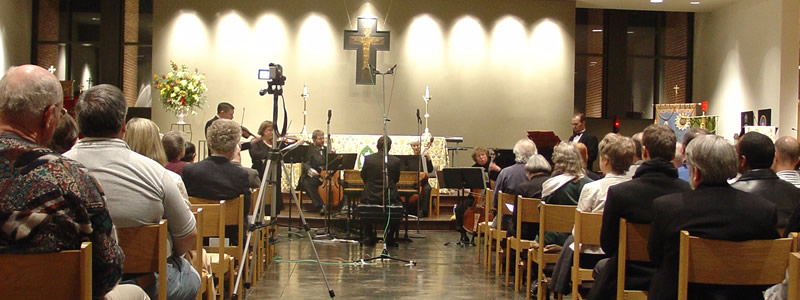
[Bach's B minor Mass]
A powerful Bach B-minor Mass from New Trinity Baroque and Georgia Tech Chamber Choir
by Pierre Ruhe
...Saturday's performance by the period-instrument ensemble New Trinity Baroque and the Georgia Tech Chamber Choir was a thoughtful, energizing exception that gave the B-minor Mass a fresh sound. Under New Trinity founder and conductor Predrag Gosta, they illuminated the various madrigal-like choruses and operatic arias with individual attention...
Emotionally heartfelt... A strong performance... Gosta conducted Saturday night at St. Bartholomew's Episcopal, which was filled to capacity... It's a special pleasure to hear a student choir sing at a high level with enthusiasm and clarity of purpose.
...The four vocal soloists were often compelling, more so in duets with the fine instrumentalists... Conductor Gosta kept it all pushing forward... His tempos were not overly fast, but they felt fleet and he ended sections with a crisp cutoff — a very pleasant sensation. The Serbian-born harpsichordist and conductor is audibly gaining in interpretive heft, in parallel with his nascent conducting career, from the Gwinnett Ballet to concerts in Russia and Eastern Europe...
(ArtsCriticAtl.com, March 2011)
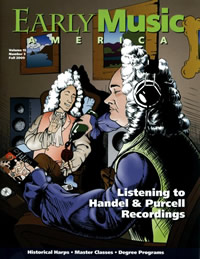 [CD of Purcell's "Dido & Aeneas"]
Dido & Aeneas: Purcell's English Opera on Disc
The focus is on the great singing actresses who have recorded the tragic Carthaginian queen.
by Craig Zeichner
...An excellent 2002 Edition Lilac recording [of Purcell's "Dido & Aeneas"] featuring Predrag Gosta leading the Atlanta-based Chorus and Orchestra of New Trinity Baroque...
This is a wonderfully colorful yet always musical performance. It is what Noorman attempted but failed in the Parrott recording. Gosta's ensemble is excellent... the playing is so sensitive and secure. The choral work is excellent, too, with a true sense of character projected by the nameless witches, sailors, and attendants. This self-produced recording... is definitely well worth acquiring � a true sleeper...
That's nine recordings of Dido and Aeneas and I haven't even scratched the surface. Which one is best? ...If I was forced to take one recording to a desert island, it would be the one by Lieberson and McGegan � but I would be sure to have Tubb with Gosta and Graham with Haim in my iPod.
(Early Music America magazine, Fall 2009)
 [Opening concert of the Piccolo Spoleto 2009 Festival]
Raves for New Trinity Baroque
Crack Atlanta "period performance" ensemble will take you back a few centuries
BY LINDSAY KOOB
Last year, I was very disappointed to miss the Piccolo Spoleto debut of New Trinity Baroque, an early music ensemble from Atlanta � for their reputation had preceded them. So color me happy when I learned that local early music guru Steve Rosenberg was bringing them back to adorn the 23rd consecutive season of his ever-popular Piccolo Early Music Series. Saturday's performance at First (Scots) Presbyterian Church was the first of five scheduled programs through May 27.
The church was pretty well-packed for the afternoon's "Grand Tour" program that explored the four great national traditions of Baroque-era Europe: those of Italy, France, Germany, and England. And, since NTB offers "historically informed" performances on original ancient instruments (or their replicas), authentic period sound and style are guaranteed.
The instruments at hand appear to be nearly identical to modern violins, violas, cellos, and double-basses. But special old-time bows and bridges are employed, and they're all strung with gut, as opposed to modern steel strings. Such original trappings � plus ancient playing techniques (like minimal vibrato) and tuning schemes � produce a distinctly thinner, sharper, and more searing sound than we normally hear.
Directed by Predrag Gosta (also the harpsichordist), NTB's five musicians are violinists Carrie Krause and Adriana post, violist William Bauer, and cellist Andre Laurent O'Neil, with Martha Bishop on violone (Baroque double-bass).
They began their musical tour with everybody's favorite early Italian master, Antonio Vivaldi, offering a scintillating rendition of one of his many concertos for strings; this one did not feature a soloist. From there, they took us to France with an elegant trio sonata by Jean-Marie LeClair.
From there, it wasn't far to Germany. We got a wonderfully inventive "canonic sonata" for two violins by Georg Philipp Telemann, plus two works by J. S. Bach (his well-known "Air on the G-string," plus two movements from one of his great solo violin partitas, played with supreme virtuosity and flair by Ms. Krause).
Although England claims him, Georg Friedrich Handel was born and raised in Germany. NTB treated us to a vibrant and fascinating "passacaglia" of his, drawn from the "balletto" (dance) sequence of one of his many Italian-style operas. The final English selection was an intricate and lovely chaconne in four parts by Henry Purcell.
If you dig Baroque music, you need to hear this terrific ensemble; they're one of America's premier period groups. You have four more chances to hear them before their current run ends on May 27 and Rosenberg's College of Charleston ensembles take over for the rest of the series.
(Charleston City Paper, May 23, 2009)
 [CD Carissimi "Jonas" & "Jephte"]
"Giacomo Carissimi (1605-1674) is best known for these two additions to the early oratorio genre, and so it is no surprise to find them recorded together on this release. What is a surprise, and a pleasant one at that, is to see that this version of 'Jonas' contains previously unrecorded material - the arias 'Sed frustra gemented' and 'Clamor hinc et inde luctus' and the duet 'Et Dii non erant.' There portions of the work are in a manuscript now located in the Czech Republic, and it is indeed fortunate that a recording of the more complete work now exists."
"...New Trinity Baroque, performing beautifully as always on period instruments, accompanies the vocal parts simply and tastefully. Despite its length of only 30 seconds, the opening 'sinfonia', in its dramatic restraint and sense of ensemble, sets the tone for the rest of the recording."
"...the instrumental portion of the recording is consistently delightful... The Oxford Chorale... does an admirable job in the choral sections, most notably in 'Fugite, cedite impiii' and the closing 'Plorate filii Israel' in 'Jephte'... On the whole, the duet and trio sections provide some of the loveliest moments in either work, as it the aforementioned 'Et Dii non errant,' which features Julia Matthews and Elizabeth Packard Arnold. It must be said, though, that Julia Matthews's rendition of the nameless daughter in 'Jephte' is particularly beautiful - definitely a highlight of the recording."
"Of the two oratorios, 'Jephte' is stronger, both in its dramatic presentation and in its musical precision. However, this is certainly a recording that would provide a great introduction to either work and would be a welcome addition to any Carissimi-lover's collection. Well done."
(Early Music America magazine, Spring 2009)
[Debut concert at the Piccolo Spoleto Festival 2008]
New Trinity Baroque [conducted by Predrag Gosta] plays superbly... The program was all Antonio Vivaldi, one of the greatest Venetian composers who wrote many concertos for strings, and he must have had a group like this in mind when he put all those mountains of notes on paper... It was an hour of exuberant music played to a fair-thee-well by a group of musicians who obviously know what they're about.
(Charleston Post & Courier, May 25, 2008)
[Debut concert at the Piccolo Spoleto Festival 2008]
Viva Vivaldi! The Red Priest Soars In New Trinity Baroque’s Piccolo Debut
From the first delicate yet driving bounce of the String Concerto in C major, RV 114, a crisp wave of clarity washed over the crowd, enveloping the church with its bright, lithesome sonorities... New Trinity Baroque received a much deserved standing ovation from a crowd that clearly wanted more...
(Charleston City Paper, May 24, 2008)

[Bach's "St. John Passion"]
"New Trinity Baroque’s 'St. John' Passion a Tour de Force"
"...Leif Aruhn-Solen, the Evangelist... brought so much tone and color to a semi-sung role... Baritone Paul Max Tipton’s portrayed Jesus with dignity, beauty, and compassion. The other vocalists were fine without exception."
"...With his period-instrument band, Gosta made a strong case for the as-Bach-heard-it authenticity of this performance, with the nine soloists singing the 'choruses,' joined on the 'chorales' by the larger church organ and choir."
"He’s likely right, to the extent that this matters, though Bach probably would have had only men and boys in his choir. But the truth is that... this probably sounded better than Bach himself ever heard."
(The Atlanta Journal-Constitution, March 3, 2008)
[CD Carissimi "Jonas" & "Jephte"]
"These are enthusiastic performances which capture the spirit of the two oratorios very well."
"...Individual singing is a bit variable but the best is very good, particularly Julia Matthews' beautiful Filia adn Patrick Newell's exciting but controlled 'Fugite'."
"...[This recording] does have much to offer, particularly in the tightly-controlled drama of its 'Jephte'."
(Early Music Review, December 2007)
[CD Charpenteir "Messe de minuit" & Handel Organ Concertos]
"...the augmentation of the vocal music by the inclusion of three organ 'noels,' an 'offertoire' (Couperin, for organ) and a concluding 'Nuit' (from H416) is much to be welcomed. As is the use of voice flutes - surely the correct 'flutes' in this repertoire'."
"...the use of Gallic pronunciation and teh general musical style are pleasing features."
"...New Trinity are a hard-working ensemble who have been blazing a trail in Atlanta for 10 years."
(Early Music Review, December 2007)
["Best of Baroque"]
"New Trinity gives baroque new life"
"New Trinity Baroque, Atlanta�s most established early music group, is entering its ninth season. But a first-time listener is struck by the earnestness and engagement of the players. This concert, billed at 'Best of Baroque,' featured some of the most popular pieces from past seasons, especially Handel and Bach..."
"A striking and charismatic blonde, Krause turns her playing into something resembling a dance... a tone that balanced sweetness with character. [Andre O'Neil's] playing is intense and, despite being stuck behind a cello, he is almost as riveting to watch as Krause..."
"[Terry] Barber demonstrated his delightfully natural soaring high register. It was easy to imagine the powerful castrati voices that once rang on the same arias.
Mueller has the kind of pure sound, with little vibrato, that is ideal for this material. Her voice was well matched to Barber�s more silvery tones, and she held her own in the duets. She showed a good sense of tragedy in Handel�s 'Lascia ch�io pianga' from 'Rinaldo,' one of the composer�s youthful masterpieces..."
"Predrag Gosta, the group�s founder, conducted from the keyboards... his tempi were lively and sensitive. His witty and informed comments enlivened the evening."
(The Atlanta Journal-Constitution, September 3, 2007)
["Unfaithful Love" - Dramatic Music by Handel]
"New Trinity Baroque on Handel and Liars We Love"
"New Trinity Baroque, Atlanta's most adventurous period-instrument ensemble...
"New Trinity's sharply planned and wonderfully performed concert..."
"Temko ... was best in the most substantive work of the evening, 'Armida abbandonata,' carefully declaiming the recitatives and often floating lovely tones in the middle of her range ...
Temko's pleasing timbre of voice and confidence with Baroque phrasing and ornaments is a major enrichment of the local period-instrument scene. One suspects we'll be hearing much more from her."
"Spaced between the cantatas, New Trinity founder and harpsichordist Predrag Gosta programmed small instrument works, each scored for two solo violins and accompaniment. In the context of so much suffering and deceit, the B minor Trio Sonata (Op. 2 no. 1) and G Major Sonata (Op. 5 no. 4) worked as ideal palate cleansers. St. Bartholomew's acoustics are lively and true..."
(The Atlanta Journal-Constitution, October 23, 2006)
["Mozart Birthday Bash"]
"New Trinity Baroque's Zesty Mozart"
"Baroque players do Mozart proud"
"...In recent seasons, conductor-organist Predrag Gosta and the period-instrument band have delivered bracing, often illuminating readings from the century or two before Mozart was born."
"...'Eine kleine Nachtmusik,' a little evening serenade, got a balanced, zesty performance. As in the Divertimentos nos. 1 and 3 - also known as Salzburg symphonies - Mozart's tunefulness flows like water from a spring, inexhaustible and pure, yet a tiny twitch in the harmony can suggest a change in mood or undercurrent of tenderness, melancholy, even despair."
"Gosta and his players were alert to these nuances... in the fast movements they touched on the exuberance of a life that, seemingly, could never end. That was another benefit of New Trinity's Mozart. Where modern orchestras present music by the tragic genius who died too young... the early music context catches him in the full flower of life, a vital presence in the here and now."
"...Carrie Krause and Garry Clarke were the robust-toned violinists, playing with power and wit, at one point improvising on 'Happy Birthday' - and getting the audience to sing - to honor the composer whose music offers endless possibilities for reinterpretation.
"
(The Atlanta Journal-Constitution, September 4, 2006)
["Baroque Before Bach"]
"Baroque group generates fireworks"
"...at their best, the payoff is simply dazzling. For a ciacona movement from Johann Christoph Bach's 'Meine Freundin, du bist schon' soprano Jennifer Ellis sang the texts with a pure and pretty voice and disarming sincerity. The ensemble gave lucid, eloquent support. And rising above it all, Holloway's silken violin playing scorched and ripped and shot sparks... Near the ciacona's end, he let loose a cascade of machine-gun fire, a 20-second flurry of notes that made everything else seem in slow motion..."
(The Atlanta Journal-Constitution, February 14, 2006)
["New Trinity Baroque's Candlelight Christmas"]
"When violinist John Holloway and New Trinity Baroque
are going full fury, no music ensemble in Atlanta
creates so much excitement. No group seems as vital."
"...they delivered the most satisfying concert of this
classical holiday season — a model for how to do it..."
(The Atlanta Journal-Constitution, December 19, 2005)
CLICK HERE TO READ FULL ARTICLE

[Charpentier's "Messe de minuit" and Handel's Organ Concerti CD]
"Music that makes the contradictory holiday jumble of feelings manageable...
Top 10:
1. Carols From Wightman Chapel (Aeolian) by the Scarritt-Bennett Singers...
2. Christmas Concertos (Archiv) by the English Concert — This is baroque music with the purity of winter air. Note a new release of an old beauty: Charpentier's Christmas Messe de Minuit (Edition Lilac), performed by New Trinity Baroque and Canterbury Choir...
3. Ella Wishes You A Swinging Christmas (Verve) by Ella Fitzgerald...
4. On Yoolis Night: Medieval Carols and Motets (Harmonia Mundi) by Anonymous 4...
...
5. The Sinatra Christmas Album by Frank Sinatra (Capitol)...
...
10. The Carol Album (EMI, 2 vol.) by Taverner Consort, Choir and Players..."
(The Tennessean, December 17, 2005)

[Charpentier's "Messe de minuit" and Handel's Organ Concerti CD]
"The quality of the recording was excellent. New Trinity Baroque is faultless in interpretation, and Brad Hughley is an enormously talented organist. The choir was a perfect compliment."
(Amazon.com, August 2005)
 [Purcell's "Dido & Aeneas" CD]
"... [Tubb's] runs are fluent, accurate and sound spontaneous, and her decorations apt and neatly done.
... Julia Matthews’s flute-like Belinda has an apt sense of style and provides a busy, bright-eyed characterization. Thomas Meglioranza’s Aeneas, sung in a warm, medium-scale baritone, is consistently vivid. There’s a clear and direct First Sailor from Kevin Sutton...
... There's clean singing from the choir, and impeccable work from the 13-piece band (including five continuo players). Predrag Gosta shows good musical instincts, and, unlike some period performers, you feel he’s willing to depart from the strict letter of the score if they lead him that way..."
(Opera Magazine, www.opera.co.uk, Vol. 56, No. 1, January 2005)
 [Purcell's "Dido & Aeneas" CD]
"...Haïm and her colleagues are finding Dido just too familiar, and are looking for something new to do with it. If new is what you're after, that at least is on offer in NTB's version of Dido."
"Thomas Meglioranza gives a thoughtful and sympathetic performance that sends a breath of fresh air blowing gently through the opera. His soft-grained voice and confiding manner suggest from the start a soft-hearted hero who really could win the heart of a young widowed queen."
(Early Music, Oxford University Press, Vol. 32, No. 4 - November 2004)
Sunday, Dec. 5, 2004
READING EAGLE / READING TIMES
Albright Concert Series offers delightful operatic production:
The intimate Wachovia Theater proves a perfect setting for a rarely performed work by Giovanni Battista Pergolesi
(by Susan L. Pena, Reading Eagle correspondent)
 The Albright College Concert Series took a little detour into opera Friday night in the Wachovia Theatre with a production of the rarely presented Baroque opera, "La Serva Padrona," by New Trinity Baroque of Atlanta.
This tiny gem by the very young Giovanni Battista Pergolesi (he died at age 26) is significant because it was one of the first comic operas, dealing with ordinary people rather than mythological figures or royals.
First produced in Naples in 1733, it was to have an impact on Mozart, whose great "Marriage of Figaro" was its descendant, as well as Rossini and many other composers and librettists who chose to deal with domestic matters.
"La Serva Padrona" features only three characters, so the Wachovia Theatre provided a perfect, intimate setting. Since it is relatively short, there was time for two oboe concertos at the beginning of each act, both in D minor - the first by Tomaso Giovanni Albinoni, the second by Alessandro Marcello.
New Trinity Baroque, founded by harpsichordist and musical director Predrag Gosta, who made some introductory remarks about the opera, uses period instruments to achieve an authentic sound in their concerts.
In this case, the "orchestra" was a quartet, clad in period costumes (including masks for the second act, in honor of the plot): violinists Daniela Giulia Pierson and William Bauer and cellist Andre O'Neill joined Gosta throughout the evening.
Oboist Joyce Alper was the soloist for the two concerti, both delightful compositions that made it clear why people are willing to coax those cantankerous early instruments into submission: The sound is very sweet, light and perfect for the pieces.
Alper's skill was apparent throughout, especially in the fetching dotted rhythms of the Albinoni opening movement, and in the serpentine melodies of the Adagios in both pieces.
The surprise of the evening was to find that Albright's own associate professor and chair-woman of the theater department, Julia Matthews, has a lovely soprano voice and in fact was once associated with New Trinity Baroque. She not only stage-directed the production, but starred as the saucy, scheming maid, Serpina.
Bass Jason Hardy played the part of Uberto, Serpina's master and the object of her desire; Kurt-Alexander Zeller played the mute role of Vespone, Uberto's other servant.
Hardy's voice was warm, creamy and easily produced, capable of conveying all the nuances of his role as the master who has lost control over his servants, and who is confused by conflicting emotions of anger and desire toward Serpina. He also has a highly expressive face, which he used comically.
Matthews' voice has a flute-like upper range as well as a very natural lower range; she shone particularly in her second-act aria, "A Serpina penserete," in which she alternated between extreme (feigned) pathos and naughty glee, manipulating Uberto into marrying her.
Zeller was impish and madcap in the style of Harpo Marx, especially when Vespone disguised himself as Serpina's violent suitor.
The final duet, "Contento tu sarai," was full of adorable "pat-a-pits," echoed in the quartet parts, bringing this silly story to a happy conclusion.
[Pergolesi's "La Serva Padrona"]
"...On Saturday, New Trinity Baroque, another ambitious local ensemble, presented Pergolesi’s comic opera of 1733, 'The Maid Mistress.' It’s the comic tale of an impertinent servant girl who weasels her way into her master’s heart. She thus swaps her maid’s cap for a wedding veil. The opera, which sounds half way between baroque Handel and classical Mozart, was highly influential, inspiring Mozart and Da Ponte’s 'Cosi Fan Tutti.'"
"New Trinity harpsichordist Predrag Gosta led a delightful show, starting with Jason Hardy singing Uberto, the rich old geezer. Hardy is a major discovery. His bass voice is wide and ringing, with an easy delivery and an Italianate “ping” in his tone..."
"Soprano Julia Matthews, as the maid Serpina, had charm and a bright, agile voice... Kurt-Alexander Zeller played the dumb and dumber valet role, Vespone."
"...The performance burst with energy and fun."
(The Atlanta Journal-Constitution, October 26, 2004)
 [Purcell's "Dido & Aeneas" CD ]
"...Although Dido itself may be a rarity, recordings of it are not. One might wonder what this latest, under the direction of Predrag Gosta, has to add to the discourse. The answer is simple: Evelyn Tubb's dual roles of Dido and the Sorceress. As Gosta and continuo leader Michael Fields explain in the liner notes, they and Tubb wished to explore the many layers of the score. Thus, Tubb portrays the Sorceress as well as Dido, singing the former as the latter's shadow ... one need only recall Tubb's earlier recording The Mad Lover to anticipate a briliant characterization.
Backed by a fine cast, including Thomas Meglioranza (Aeneas), Julia Matthews (Belinda), and Allison A. Brown (First Witch), Tubb sings splendid Dido, but it is as the Sorceress that she truly makes this recording stand out from other versions. This strategy adds new verve and richness to a work that often seems only a vehicle for sopranos to record 'Dido's Lament'."
(Early Music America magazine, Fall 2004)
[Pergolesi's "Stabat Mater"]
"New Trinity Baroque is one of Atlanta's most prized ensembles. A group of ambitious free-lance musicians, led by organist Predrag Gosta, they play on period instruments and consistently deliver vital, artistically satisfying programs."
"Soprano Eyelyn Tubb's voice shifts between those poles, both sacred and profane, angelic and earthy. Countertenor Terrance Barber's... grasp of the texts and elegant phrasing made for charismatic singing. Their blended voices, with the infectious enthusiasm of the New Trinity musicians, made for a sublime mix."
(The Atlanta Journal-Constitution, April 5, 2004)

 "... New Trinity Baroque, led by harpsichordist Predrag Gosta, takes a renegade tact, dusting off obscure scores and, more often than not, finding life in them."
"... for the money... New Trinity makes for a more exciting evening."
(Gramophone, April 2004)
CLICKE HERE TO READ FULL ARTICLE

["L'Incoronazione di Poppea" by Claudio Monteverdi]
"Baroque opera delivers compelling music, cast"
"... marvelous performances by the New Trinity Baroque."
"... 'Poppea' is unique and engaging."
(Dag Ryen, Lexington Herald-Leader, March 27, 2004)
["In the Shadow of the Sun King"]
"Concerts span the musical universe"
"... the ultra-refinded elegance of Baroque cantatas..."
"... impassioned performances..."
"... taut and loaded with nuance."
(The Atlanta Journal-Constitution, November 17, 2003)
[Vivaldi's "Four Seasons" and other virtuso concerti]
"Twist takes baroque event higher"
"New Trinity Baroque's concert Sunday at Peachtree Christian Church was progressing splendidly..."
"... the simplest gesture elevated an attractive, if ritualized, concert to an unexpected level of intimacy..."
"...It was a goosebump moment: a combination of Fields' winning musical charm, hearing the subtle instrument up close --- amplification the old-fashioned way --- and a certain Bill Clintonian, touchy-feely empathy for the attentive audience. We were in this together, and the mutual appreciation was near complete."
"The concert marked the opening weekend of New Trinity Baroque's fifth season, a remarkable occasion. Founded and led from the harpsichord by Predrag Gosta, New Trinity is an ad hoc period instrument ensemble of consistent merit and refinement, boasting the highest artistic values."
"...the stylish playing of the orchestra, especially from violist William Bauer (who was also soloist in a viola d'amore concerto) and contrabassist Joshua Lee, where supporting players more than carried their weight --- a sign of a finely tuned group."
(The Atlanta Journal-Constitution, September 16, 2003)
 [Purcell's "Dido & Aeneas" CD]
"...British soprano Evelyn Tubb... perfect for this role, which has had many excellent and experienced interpreters, but maybe none that have moved the audience as Dido should be able to... her final lament had every person in the audience in tears, plus everyone on stage."
(Early Music Today, February/March 2003)

"...New Trinity Baroque, one of the world's leading early music ensembles on period instruments."
(Gwinnett Daily Post, February 2003)
"...The performance was lively, interesting and professional ... the quality of the recording showed the same concern for excellence that the performance itself did."
"Words that come to mind in listening to the performance were: defined, gripping, thoughtful, full of temperament, fearless. The very first notes commanded attention..."
(Edward Brewer, Concert Artists Guild, New York, January 2003)
CLICK HERE TO READ FULL REVIEW
[New] Trinity Baroque relies on talent, not staging, for great 'Dido' show:
"...'Dido and Aeneas' was skillfully, passionately performed..."
"... exuberant and exactingly prepared..."
"Never mind that the opera was nearly semi-staged - no costumes, just a little acting, and the church altar as the only set. This group thrives on ideology. With gut-stringed instruments, the musicians go for lean, slightly pungent timbres, emphasizing the music's skeleton and muscle, with little fat."
"The cast was excellent ... British soprano Evelyn Tubb, as the rejected heroine, sang in pure unadorned voice, affecting in delivery, full of darkness and pathos while never appearing to sulk. She spun a long, easy, lyrical line for her final lament, 'When I am laid in earth.' We felt for her."
"... Thomas Meglioranza, as Aeneas, looked smarmy with a slick-back ponytail, and his baritone was seductive. Others in the cast etched memorable characters..."
"... Although it performs just a few times a season, New
Trinity Baroque is an ensemble worth following."
(The Atlanta Journal-Constitution, September 9, 2002)
 "... a very significant and impressive early music program ... The rich melodies were superbly performed by 21 voices and 12 instruments, including baroque violins, baroque cello, harpsichord, chitarrone, organ, recorders, three cornettos, and three sackbutts. The music was hauntingly beautiful, and sensitively conducted and performed. The voices and choir sang so perfectly in tune that many harmonic overtones thrilled the ear."
"... The clear tone of the Mr. Aruhn-Solen rang out over the audience while Mr. Hagan's responses echoes from the back. After the piece, you could hear a pin drop in the sanctuary as the audience seemed stunned for several seconds."
"... It was a marvelous performance by 33 outstanding musicians. Both performances received a standing ovation. Mr. Gosta is to be congratulated for bringing this music and these performers together."
"... This is the most outstanding musical performance that I have heard in Atlanta since I came here in 1976... This is the best cornetto playing that I have ever heard in a live performance... one of the best early music performances this year."
(The Pipeline - Newsletter of the Atlanta Recorder Society, May 2002)
CLICK HERE TO READ FULL REVIEW
Monteverdi Vespers Puts Feather in NTB Cap:
"Mustering what in the early music world ranks as mighty forces, Predrag Gosta and his New Trinity Baroque ensemble presented the Vespers of the Blessed Virgin (1610) by Claudio Monteverdi in two performances..."
"...particularly delightful ... was the work of tenor Leif Aruhn-Solen of Sweden and the duet of sopranos Julia Matthews and Elizabeth Packard Arnold ... these three were able to take control of the musical arc so that the ornamentation provided intensification of the phrase, not just vocal acrobatics. This resulted in a compelling interpretation of the text..."
"...monodic solos and duets were ably accompanied by Michael Fields of England on the chitarrone."
"...The ensemble of singers and instrumentalists was precise and well tuned ... the 'amen' at the end of a psalm often had a gratifying sense of growth and resolution. This may be traced directly to conducting ... during the 'amen' [Mr. Gosta] often called for and got a lovely effect."
"...Instrumentalists provided vibrant color as well as many moments of excitement, such as the violin duo in the Sonata sopra Santa Maria (James Gallagher, Mirna Ogrizovic) and the cornetto duo during the Magnificat..."
"...[a recording] can never substitute for a live performance of the quality we heard from New Trinity Baroque."
(Broadside - Newsletter of the Atlanta Early Music Alliance, Mar./Apr. 2002)
New Trinity Baroque Succeeds with Baroque Favorites:
"... Artistic Director Predrag Gosta lent his rich baritone voice to the vocal numbers."
"... The group's sense of tempo and ensemble was spot on with each variation flowing seamlessly upon the prior one."
"... Mr' Gosta's clear diction and fine tone declaimed the text beautifully."
"... The difficult ornaments in the Laudate were carried off beautifully."
"... Mr. Gallagher showed secure and accurate technique on the violin along with a fine interpretation of the material. Mr. Husey provided solid grounding as well as beautiful solo in the third movement."
"... The entire ensemble participated in this festive closer bringing an end to a lovely concert."
(Broadside, February 2002)
CLICK HERE TO READ FULL REVIEW
"The whole ensemble was delightful ... their intonation was perfect, and their ensemble was uncanny."
(Broadside, September 2001)
 "... New Trinity has a bright future as a chamber vocal ensemble."
"... I foresee the group becoming a valuable addition to the early music scene in Atlanta."
(Early Music News, Atlanta,
March-April 2000)
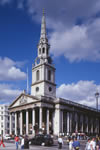
"St. Martin-in-the-Fields has welcomed talented musicians to this central London platform for over 50 years - from highly acclaimed young soloists, to choirs from all over the world; from promising new ensembles, to established professionals..."
(St. Martin-in-the-Fields,
London, March 27, 1998)